
Rolly Vortex
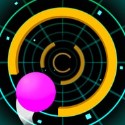







In Rolly Vortex you start already rolling forward at speed, dropped straight into a neon-lit cylindrical tunnel with no ramp-up period to get comfortable — your only real choice from the first second is which way around the inner wall to steer, and that single decision repeats, faster and faster, for as long as you can keep from clipping a wall.
| Genre | Tunnel-rolling arcade game |
| Setting | An infinitely stretching cylindrical tunnel called the Vortex |
| Core mechanic | Hold and drag to rotate the ball around the inner wall |
| Collectibles | Coins, speed boosts, invincibility shields |
How Rolly Vortex Replaces Ground With a Rotating Tunnel
What separates Rolly Vortex from a flat-ground runner is that the entire play space curves around you. The ball moves forward automatically, and your input — click, hold, or touch and drag — rotates it around the inside wall of the tunnel rather than moving it left or right across open ground. That distinction matters because obstacles aren't just ahead of you, they're positioned around the full circumference of the tunnel, so reading a threat means checking where it sits on the wall relative to your current position, not just how far away it is.
In Rolly Vortex, Static Walls Are the Easy Part
The most basic hazard in the Vortex is a static wall segment blocking part of the tunnel's circumference, and these are forgiving early on simply because the tunnel's rotation speed hasn't ramped up yet. The real difficulty comes once spinning beams and closing ring gates enter the mix, since both introduce timing on top of positioning — a gap that's safe right now can close, or get swept by a beam, in the half-second it takes your ball to actually reach it.
Debris and the Cost of a Late Read
Loose debris scattered through later stretches of the Vortex behaves less predictably than the fixed obstacle types, and it's usually what catches players who've gotten comfortable reading the more structured hazards. Because the ball's forward speed never lets up, a hazard you notice late doesn't give you time to recalculate — the practical skill Rolly Vortex is really testing is how early you can commit to a rotation direction, not how quickly you can react once an obstacle is already close.
When the Vortex Itself Starts Speeding Up
On top of your own forward momentum, the Vortex's rotation speed shifts on its own as a level continues, and that changing pace is arguably a bigger source of difficulty than any single obstacle shape. A rotation speed that felt manageable a few seconds earlier can suddenly outpace your steering, and players who do well tend to describe adjusting their drag speed constantly rather than settling into one fixed steering rhythm for an entire run.
Coins, Boosts, and Shields as Risk Management
Coins scattered through the tunnel add to your score without much extra risk, but speed boosts and invincibility shields change the calculus of a run more directly. A speed boost pushes you through a hazardous stretch faster, which helps against slow-closing gates but can also shrink your reaction window against a spinning beam you hadn't fully read yet. An invincibility shield, by contrast, is the safer pickup of the two, letting you push through a stretch of debris or a static wall without needing a perfect rotation — though shields don't last long enough to lean on for an entire run.
Chasing Score Versus Chasing Distance
Among players, there's a fairly consistent split between those optimizing for a long, clean run and those diving toward coins even when it means a riskier line through the tunnel. Neither approach is clearly better since Rolly Vortex rewards both a high score and simple survival distance, and which one a given player chases usually says more about whether they enjoy the game as a collection challenge or as a pure reflex test.
Does the tunnel's rotation speed increase at a fixed rate?
The Vortex's rotation speed shifts as a level progresses rather than staying constant, adding a layer of challenge on top of the ball's own forward speed — players generally describe needing to adjust their steering pace continuously rather than settling into one fixed rhythm.
What's the difference between a speed boost and an invincibility shield?
A speed boost increases the ball's forward momentum temporarily, which helps clear some hazards faster but can also shrink your reaction time against others, while an invincibility shield lets the ball pass through obstacles like debris or static walls without penalty for a limited window, making it the more forgiving of the two pickups.
Is it better to chase coins or just focus on surviving longer?
Both are valid ways to play Rolly Vortex since coins build your score while distance alone still counts as progress — players optimizing for a high score tend to detour toward coin clusters even near closing ring gates, while players chasing a long clean run usually skip a coin the moment it puts them closer to a spinning beam or debris.
Rolly Vortex never really changes its core ask — hold, drag, rotate — but it keeps layering that simple input against a tunnel that spins faster, closes gates tighter, and scatters debris more unpredictably the longer a run continues. The whole appeal comes down to how long you can keep committing to a rotation direction before the Vortex outpaces your read on it.